This article was originally published in the Trotter Review on September 22, 2016
Former Confederate Capital Tries to Memorialize Its Shameful History of Slavery
Mayor Dwight C. Jones had the noblest of intentions.
With Virginia’s capital having a poverty rate of nearly 25 percent, no one blamed Jones, a child of the sixties and preacher by calling, for trying to develop prime riverfront property to generate revenue to create more jobs, better schools, and housing.
But when Jones unveiled a proposal in 2013 that included building a new baseball stadium near one of the city’s historic slave burial grounds in Shockoe Bottom, it was, by all accounts, troubling to historic preservationists and Black community activists. “Shameful” was one of the words most often used.
Jones, the city’s second African American mayor after former Virginia governor L. Douglas Wilder, defended the proposal as a tool to combat poverty, a modern-day issue that he in religious terms likened to “an abomination” that needed, no required, the engagement of city government.
To that end, during his first administration, Jones unleashed an anti-poverty program that rivaled in tone all of the blue-ribbon commissions and groundbreaking studies that President Lyndon Johnson ordered during the 1960s. “The first point in dealing with the city’s poverty is to acknowledge that it exists,” Jones told the Washington Post. “Then we have to deal with the ramifications of that truth and find a strategy to change the history that we have in the city of Richmond.”
Given the history of Virginia, and its romantic memory of the Old South, truth depends on who tells the stories. Up until recent times, the story of slavery in Richmond was buried and forgotten. To his credit, Jones at least remembered the burial ground, which dates to at least 1809, and he included the construction of a slave memorial and $30 million museum in his controversial proposal.
Even months after Jones had dropped the stadium from his revitalization plan, he remained steadfast in his desire to build what he calls a “proper memorial.” As Jones told public gatherings convened in the summer of 2015 to hear thoughts and comments on a future slave memorial: “We have an opportunity to bring honor to our ancestors and to bring justice for those who deserved to be recognized.”
That darker truth was not always part of the public memory in Richmond. In the early 1990s, human bones and cultural artifacts were discovered some 25 feet underground during the construction of a new medical building on the campus of Virginia Commonwealth University, commonly called VCU.
Though the school allowed archaeologists to sift through the site and find what the Smithsonian Institution later deemed to be a significant discovery, the university opted to finish construction of the $200 million building.
Without much fanfare, VCU filled the site and paved right over the burial ground.
On this point, Jones and his critics all agree: Shockoe Bottom will be different.
“Devil’s Half Acre”
The city’s most notorious slave-trading site rests behind the train shed at Main Street Station and underneath enormous concrete trestles supporting interstate highways. Even now, it is barely noticeable from nearby thoroughfares. Parts of it have been lost forever.
With the exception of local historians, few even knew the “Burial Ground for Negroes” or a slave jail was there. Located a few blocks from the state’s capital and Richmond City Hall, the Lumpkin’s jail site had been torn down in the late 1870s or 1880s and then buried beneath a parking lot at Virginia Commonwealth University.
In 2009, after five months of digging, researchers and archaeologists uncovered the foundation of the two-and-a-half-story brick building. Buried under nearly 14 feet of earth, the jail was down a hill some eight feet below the rest of Lumpkin’s complex. The slave jail stood in one of the lowest parts of Richmond—a sunken spot known as Shockoe Bottom.
From the 1830s to the Civil War, Richmond was the largest American slave-trading port outside of New Orleans. The Lumpkin’s complex was called the “Devil’ Half Acre” and sat amid tobacco warehouses, iron foundries, and other legitimate businesses.
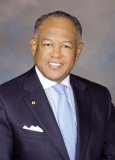 After one false start, Mayor Dwight C. Jones has laid plans for development in Richmond to preserve historic landmarks related to slavery and generate revenues to build a better future for the former Confederate capital. He vows to “bring honor to our ancestors” and “bring justice for those who deserved to be recognized.”
Courtesy of the City of Richmond, Virginia.
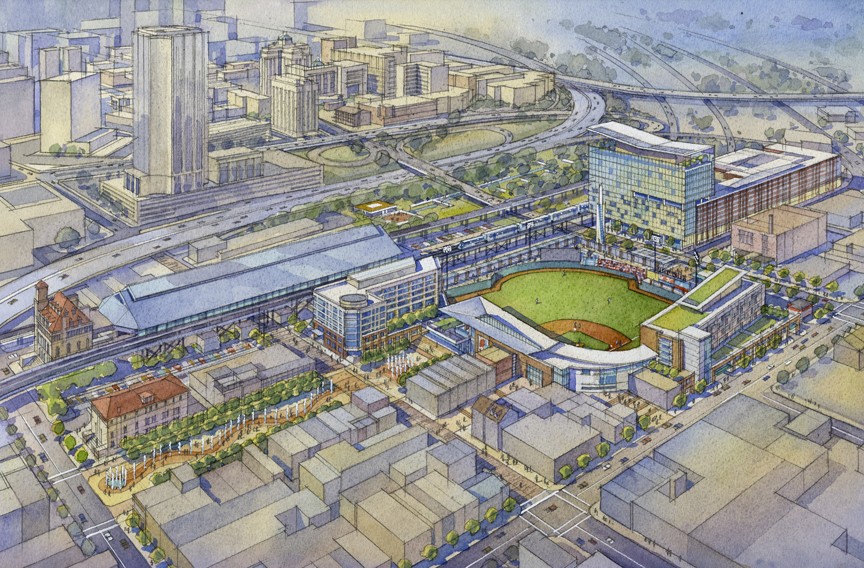
In 2013, Richmond Mayor Dwight Jones included a sunken stadium for the city’s minor league baseball team in a mixed-use development planned near a slave burial ground. The African American mayor acknowledged the area’s role in human bondage by also proposing a slave memorial and museum at a cost of $30 million. Jones dropped the stadium from the plan for Shockoe Bottom after encountering public opposition.
 Courtesy of the City of Richmond, Virginia.
Matthew R. Laird is a partner and senior researcher with the James River Institute for Archeology Inc. Between 2005 and 2010, he was one of the principal investigators of the site. He said it was one of the most important and unique sites that he has worked over his 20-year career.
“No other site has had the combination of such a compelling history and powerful story to tell, and such an incredibly well-preserved historic landscape—a physical space that you can actually see, feel and be immersed in,” Laird wrote in an essay published in the Richmond Times-Dispatch. “We were literally transported back into time, into an era of Richmond’s history that had long since been buried and largely—some might say conveniently—forgotten.”
The archaeologists uncovered the preserved cobblestone courtyard and the kitchen building. They also found a massive brick wall that divided the site into two distinct levels: the upper, “public” level, where Robert Lumpkin entertained his clientele, and a lower, sunken area, near Shockoe Creek. It was there that they discovered the remains of the jail, deeply buried.
Historians claim that in the center of the burial ground once stood the gallows. Most prominent among the hanged was Gabriel Prosser, who in 1800 led a failed rebellion. Prosser and three dozen others were hanged and presumably buried. No one knows exactly where.
There were four main buildings, the largest a two-story brick house with barred windows. Surrounding it were smaller jails, a trader’s office, a kitchen and bar, and the auction platform, all enclosed within a tall wooden fence topped with iron spikes.
According to the Richmond Slave Trail Commission, a city agency started in 1989, between 40,000 and 80,000 slaves were sold each year in Richmond. Before the end of the Civil War, historians estimate that 350,000 slaves were auctioned.
By then, writes Andrew Ward in The Slaves’ War: The Civil War in the Words of Former Slaves, 28 men had openly advertised themselves as slave traders. Dozens of others, he adds, described their occupations as dependent on the slave trade: “auctioneers,” “merchants,” and “commission agents.”
Business was booming. “In fenced-in pens, on courthouse steps, in basements and warehouses, agents auctioned off as many as two hundred slaves a day,” Ward writes.
Robert Lumpkin may not have been the wealthiest trader, but historians say that he was among the most prominent, traveling through the South and buying unwanted slaves. In the 1840s, he purchased an existing jail compound in Richmond with a designated “whipping room.”
Though known as a man with a flair for cruelty, Lumpkin was also described by historians as a “good natured fat man, professional looking,” always “neatly dressed and swinging a slender gold headed cane.” He was a favorite with buyers, The Negro in Virginia explains, “because of his excellent stock and his royal entertainment of traders.”
Though Lumpkin was among the noted traders of his day, his line of work to some in Southern society was viewed as distasteful. He belonged to “a class of persons whose society the slaveholders of the South profess to feel disgraced, but with whose services, nevertheless, they cannot dispense,” writes historian Charles Emery Stevens. “Roaming over the country, and picking up a husband here, a wife there, a mother in one place, and an alluring maiden in another, he banded them with iron links…”
Early in the 1850s, Lumpkin bought an especially “fine batch.” One, a young girl named Mary Ann, was “so presentable” that he decided to keep her for himself. “The wife of this man,” Stevens writes, “ was a ‘yellow woman’ whom he had married as much from necessity as from choice, the White women of the South refusing to connect themselves with professed slave traders.”
Historians describe Mary as “grateful. “Saved from the terrors of the cotton country, the girl did all she could to show her gratefulness,” The Negro in Virginia explains. “She bore him five children, and became Robert Lumpkin’s legal wife at the close of the Civil War.”
Mary had at least some contact with the slaves her husband kept in chains. On one occasion, she smuggled a hymnal into the prison for an escaped slave named Anthony Burns. He had fled Virginia but was recaptured in Boston in an infamous case that raised national outrage over the Slave Fugitive Act. Many believe the episode was seminal to the onset of the Civil War. Under the federal law, escaped Blacks could be returned from free states in the North to the South and their masters. A federal judge in Massachusetts upheld the statute in the face of the violent anti-slavery protests and sent Burns back south.
Burns was confined in Lumpkin’s jail for four months in 1854 until northern abolitionists purchased his freedom. In a biography of Burns, historian Stevens writes that Burns was isolated in a room “only six or eight feet square,” on a top floor accessible by trapdoor. Most of the time, he was kept handcuffed and fettered, preventing him from removing his clothing by day or night.
“His room became more foul and noisome than the hovel of a brute, loathsome creeping things multiplied and rioted in the filth,” Stevens writes. “He was fed putrid meat and given little water and soon fell seriously ill. Through the cracks in the floor he observed a female slave stripped naked for a potential buyer.”
Burns account is not the only dehumanizing memory of Lumpkin’s jail. Former slave William Kinnegy of North Carolina, in an oral history collected as part of the Federal Writers Project during the Depression, recalled how a Richmond slave trader “made us strip stark naked; the women in one part of the room, the men in another; a rough cotton screen separating the two sexes. We were stood off at a short distance from our purchasers, and our physical condition fully considered and remarked upon, holding up our hands, turning around, and then when we were sold accordingly. They did not call us people, but stock. In Richmond they called us ‘droves of stock, heads of stock’…”

The slave jail in Richmond’s ShockoeBottom, demolished in the 1870s or 1880s, has since been buried beneath a parking lot at Virginia Commonwealth University.
Gabriel Prosser, who led a failed slave revolt in 1800, was hanged nearby. This image of Robert Lumpkin’s jail appears in an 1895 book by Charles Corey, A History of the Richmond Theological Seminary. Courtesy of Virginia Union University Archives.
A National Tragedy
The Lumpkin’s jail site has haunted Delores McQuinn, an elected delegate to the Virginia House from Richmond, since her initial visit in 2003.
“I started weeping and couldn’t sleep,” McQuinn told Smithsonian. “There was a presence here. I felt a bond. It’s a heaviness that I’ve felt over and over again.”
The air is heavy in Richmond.
No one really listened to the slaves. Their stories were rarely written down, and when they were, their eyewitness accounts and testimonies on Emancipation were quickly dismissed.One of the leading proponents of slavery as a benign institution, historian Ulrich B. Phillips, dismissed slave narratives as “hopelessly tainted, unfit to use even as ‘supplement’ to other superior sources.”
Historians at the turn of the twentieth century were more focused on reconciling the differences between the North and South—not healing the wounds of a people subjected to a wretched existence devoid of legal, political, or social rights. The actual remembrances of ex-slaves were replaced by the popular romantic fantasies of Thomas Nelson Page and Joel Chandler Harris. They extolled the virtues of the Old South—and slave loyalty.
“The poetry of the ‘Blue and Gray’ is much more acceptable than the song of the black and the white,” bemoaned Christian Recorder editor Benjamin Tanner in 1878. “The very remembrance of our experience is hideous.”
Very few wanted, much less were able, to reconcile the differences between Blacks and Whites. Even among Blacks, then and even now, the question of slavery, the collective memory of it all, remains an unhealed, visceral wound. For many African Americans, history meant shame, a racial stigma, a condition largely ignored in a culture that prides itself on self-made success and personal responsibility.
American consciousness was unmoved.
A generation later, Richard Wright would describe this historical shame in his 1941 book Twelve Million Black Voices. “When we compare our hopelessness with the vast vistas of progress around us, when we feel self disgust at our bare lot, when we contemplate our lack of courage in the face of daily force, we are seized with a desire to escape our shameful identification.”
In many ways, the absence of Black voices in the memory of slavery and the times in which it thrived is a national tragedy.
“Romance triumphed over reality,” writes Andrew Blight in Race and Reunion. “Sentimental remembrance won over ideological memory. For Americans broadly, the Civil War has been a defining event … as a culture we have often preferred its music and pathos to its enduring challenges, [and]… unresolved legacies.”
Novelist Charles Chestnutt echoed that sentiment in Marrow of Tradition, his fictionalized account of the 1898 White supremacist takeover of the local Wilmington, North Carolina, government that left as many as 200 Blacks dead in a violent attack on a Black neighborhood. The “weed” of slavery had been cut down, Chestnutt wrote, but “its roots remained, deeply imbedded in the soil, to spring up and trouble a new generation.”
The Lost Cause
And so it remains with the Lumpkin’s jail site.
In the summer of 2015, Mayor Jones announced that he still wanted to rekindle the city’s efforts to memorialize the district’s slave history. Gone are efforts to build a stadium for the city’s Triple A baseball team, the Richmond Flying Squirrels. Gone from the plans are the trendy restaurants and hotels.
Though Jones still believes the neighborhood needs an economic engine to reverse the area’s widespread poverty, stressed that the historical commemoration should be developed “in ways that establish a proper sense of balance and fairness …to tell a richer and more accurate story of Virginia’s history.”
Jones now believes a pavilion dedicated to the memory of slaves should standalone. One of the richer stories about the site involves his alma mater—Virginia Union University.
During the chaotic years in Richmond following the Confederate surrender in April 1865, the American Baptist Home Mission Society organized two schools and sent eleven teachers to instruct the hundreds of freedmen. In 1867, historians recount, the Rev. Dr. Nathaniel Colver, abolitionist pastor of the Tremont Temple in Boston, came to Richmond to train Negro ministers. After searching for a suitable building, he met a woman who offered him one.
That woman was Mary Ann Lumpkin, and the building was the old Lumpkin’s slave jail. On July 1, 1867, Colver leased the jail for three years at a rental of $1,000 a year.
According to an account published in The Negro in Virginia: “Cells were knocked apart, bars were removed, and appropriately enough, down the gloomy corridors where once had rolled the despairing cries of slaves up for sale, there now rang the “a-b, ab; a-c; bac, bac” of enthusiastic beginners in the mysteries of the alphabet. Children, fathers, mothers, and even grandparents flocked to old Lumpkin’s jail for instruction.”
Despite his knowledge of history, Jones’s new vision is in large part the result of the widespread opposition voiced after releasing his initial plan. An eclectic group of community activists and historical preservationists, young and old, Black and White, opposed the idea and a majority of Richmond City Council refused to sign off on it. Opponents have said they wanted a nine-acre memorial park that would encompass the area around Lumpkin’s jail complex, the African burial ground, and two additional city blocks.
Though a final vision remains undetermined, the slave memorial in Shockoe Bottom will stand in stark contrast to Richmond’s enduring worship of the Lost Cause.
Enormous in scope and clear in purpose, the statues of Confederate leaders adorn what is described as “one of America’s most splendid turn of the century residential boulevards” that was designed to rival Boston’s Commonwealth Avenue or New York’s Fifth.
Hailed by architects as “the best of Beaux Arts planning ideals and the aspirations of the City Beautiful movement,” Monument Avenue, for most African Americans, remains a symbol of second-class citizenship.
Rebel worship took shape shortly after the end of the Civil War. In less than a decade, on October 26, 1875, more than 50,000 people witnessed the unveiling of a statue of Confederate General Stonewall Jackson. It was an unprecedented ceremony at the time and marked the first significant monument toward a Southern revival.
It was not the last.
The equestrian statute of Robert E. Lee came on May 29, 1890. Twenty-five years after he surrendered his troops in Appomatox, Lee was now sitting high on his horse, Traveller, enshrined as one of the nation’s most tragic of heroes, a loser defending freedom for the Southern cause.
John Mitchell, Jr., the fiery editor of the Black newspaper Richmond Planet, wrote about his concern over what future generations would say about such gilded monuments. According to his biographer Ann Field Alexander in Race Man: The Rise and Fall of the Fighting Editor John Mitchell Jr., Mitchell was an avid reader of history and “keenly aware of the importance of monuments and what historians today call ‘memory.’”
“What does this display of Confederate emblems mean?” Mitchell asked in the Planet two days after the unveiling. “What does it serve to teach the rising generations of the South?”
His concern was not unfounded. According to Alexander, Mitchell was afraid that future historians might miss “the fact that African Americans served the Richmond city council in the 1890s, and that the sons and daughters of slaves operated banks, insurance companies, hotels, and stores in Jackson Ward.”
Setting the record straight, however, was in the hands of Southerners hell-bent on reestablishing themselves socially and politically as well as championing their view of what historians appropriately call The Lost Cause.
It was also appropriate, then, following The Lost Cause school of thought, that Jefferson Davis, the president of the Confederacy and a Mississippi slaveholder, would receive the highest place on Monument Avenue. Unveiled in 1907, the statute of Davis features a semicircle of 13 columns that represent the states that seceded during the civil war and the two other states—Kentucky and Missouri—that participated in the Confederate Congress.
A bronze figure of Davis stands atop a 12-foot pedestal. “Vindicatrix,” an allegorical figure of the South, is perched on a 67-foot column. The statue was unveiled in the summer of 1907 and drew an estimated crowd 125,000 on the final day of a Confederate reunion.
The Richmond Times-Dispatch story called the occasion “a vindication of President Davis, an utter rout for the army of slanderers, and above all, a noble tribute to the memory of the ‘Lost Cause.’”
Tennis legend Arthur Ashe is the lone African American memorialized on Monument Avenue. The statue, erected in 1996, depicts Ashe waving a book and a tennis racket above the heads of several children. At its tallest point, the Ashe statue rises to a height of 28 feet. It is dwarfed in comparison to his Confederate neighbors.
Moving Forward
The city has already started memorials of its slave history. In 1998, the city convened its Slave Trail Commission and charged the agency with developing a vision for memorializing slave history. As it is now, the Slave Trail has 17 stops, starting near the Manchester Docks on the James River and ending at the First African Baptist Church. There is a stop at the slave burial ground, another at Lumpkin’s Jail.
The Reconciliation statue is yet another stop. Located near 15th and Main streets, the 15-foot, half-ton bronze statue memorializes the England, Benin, and Richmond triangular trade route. Identical statutes are in Benin and Liverpool. The Richmond statute was unveiled on March 30, 2007, and came on the heels of the Virginia General Assembly’s unanimous vote expressing “profound regret” for the involuntary servitude of Africans.
On August 13, 2015, Jones stood near the beginning of the Slave Trail and launched a community engagement process dubbed “Richmond Speaks.” Jones explained that the process will prepare the city to “get something physical and tangible” at the site of the infamous slave pen in Shockoe Bottom.
“We need to get input from the citizens of Richmond so that they can tell us what they want the experience to feel like to them,” Jones said.
The city has allocated $8 million in local funds to memorializeShockoe Bottom’s history. An additional $11 million in state funding is also available.
But two other proposals are on the table. One of them was offered by the Defenders for Freedom, Justice & Equality, the grassroots organization that played a significant role in the opposition to Mayor Jones’s revitalization plan. Its members packed City Council meetings, led rallies and vigils, sent press releases, and saw about 4,200 people sign a petition against Mayor Jones.
Instead of the mayor’s new proposal, the group is calling for a historic overlay district in Shockoe Bottom that would include markers and guide commercial and residential development. It also calls for a memorial park to replace the crumbling parking lots.
“It should be treated as a site of conscience where the public can come together to confront the long-term impacts of slavery and racism in order to promote healing,” the group stated in its eighteen-page proposal.
The National Trust for Historic Preservation agrees with their sentiments. Last year, it described the site as one of the nation’s 11 most endangered, and proposed an eight-block area in Shockoe Bottom be preserved as a “site of conscience,” where visitors can learn from “this dark chapter of American history.”
The idea of memorializing slave history is not new in Virginia. Back in 1981, Wilder, then governor of Virginia, created a nonprofit organization to build a national slavery museum. Though his organization filed for bankruptcy in 2011, Wilder told the Richmond Times-Dispatch in October 2015 that he was still working on his own plans—this time with Virginia Commonwealth University—to build a slavery museum in downtown Richmond. No further details were made public.
But even as Richmond tries to move to the future, its past continues to burden its promise. An incident during a much-anticipated, international cycling competition in the city made that clear. Four years in the making, city officials had secured the return of the 2015 World Championship of cycling to the United States for the first time in 30 years.
Event organizers estimated that 450,000 spectators would line the streets of Richmond—plus another 300 million television viewers across the world—and the city was expected to reap untold millions in media exposure and tourism dollars.
Most important and left unstated was that the cycling event was also expected to move the city beyond its tortured, complicated past and demonstrate, at least for a moment, that “the state of this city is resurgent,” as an excited Mayor Jones proudly proclaimed during his 2015 State of the City address.
The past in Richmond is not so easily dismissed. On the first day of the event, the Virginia Flaggers, an organization composed of descendants of Confederate Army soldiers and their defenders, gathered near the bronze-and-granite statue of Jefferson Davis on Monument Avenue and hoisted about a half-dozen Confederate flags.
If that wasn’t enough of a provocation, they also hired a noisy prop plane that flew over the city carrying a banner of the Confederate battle flag and the slogan “Confederate heros matter.”
That their slogan mocked the words of the national movement that arose in the wake of highly publicized killings of Black men by police is indisputable. That the word “heros” was misspelled only added to the ridicule. As one Richmond newspaper columnist wrote of the act, “it didn’t enhance the image of the city.”
To say the least. Among those “horrifically” embarrassed was Phil Wilayto, a member of the Defenders for Freedom, Justice & Equality. His group had also gathered near the Jefferson Davis statue, not to honor the glory of the Lost Cause, but to protest the very inclusion of Monument Avenue and its Confederate shrines as part of the cycling route.
“We didn’t think it would be a good thing for the race to circle this monument without somebody in Richmond saying this doesn’t represent us,” Wilayto told reporters, referring to the official route calling for riders to pass the Davis statue 16 times during the various heats. “We were there to make a statement to the world.”
For his part, Jones says he is not too concerned with the modern-day fuss over the Confederacy. “The confederate monuments are rightly seen by many as connected to an unjust cause that represented a desire to maintain the institution of slavery,” Jones told the Richmond Times-Dispatch. “This inhumane history is, unfortunately, a real part of the history of Virginia… What I know is they didn’t win and no amount of statutes erected to heal wounded pride will ever change that revered truth, so monuments don’t trouble me or threaten me in any way.”
Jones said he is more concerned with telling a more accurate story. “Rather than tearing down,” Jones said in a statement,“we should be building up in ways that establish a proper sense of balance and fairness by recognizing heroes from all eras.”
That is true, but whether Richmond can build an appropriate monument to slavery, given the history and modern-day politics, remains unclear. What is clear is that Shockoe Bottom remains at the center of vigorous debate.
And, as Mayor Jones likes to say: “It’s personal.”
 Journalist & Author Howard Manly